SuperCharge your learning! - Core Concepts
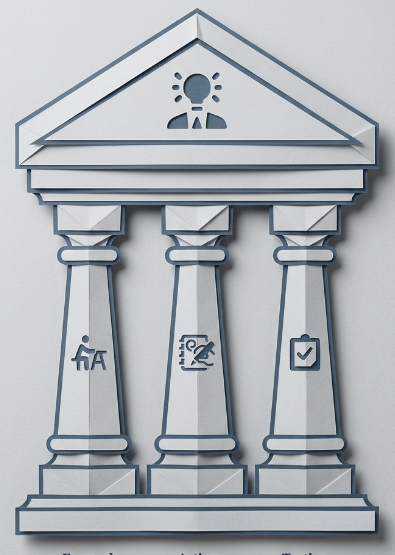
Summary
Learning how to learn might be one of the most useful skills you can have, because it helps you learn pretty much anything else faster and better. The key is to be both focused and active while learning, instead of simply reading or listening and hoping the information sticks. Let me convince you HOW & WHY this works!
Why it matters
What’s the number one subject you should learn? Is it math or science, since the emphasis on it in our society is so big? Or perhaps psychology, since you can apply it to every human interaction you have? Or perhaps learning AI in this ever-so-fast-growing world?
Well, I’d say it has to be learning how to learn. Why? Because if you know how to learn effectively, it means you can learn all those other subjects much faster and better. It then doesn’t matter if a new topic arises, like for instance AI. Since you are a master learner, you’ll be able to learn and apply that new topic faster and be on board with the rest of the world.
Also, it simply saves you massive amounts of time. Think about all the time you have to spend learning or remembering stuff throughout your life.
Wouldn’t it be great to cut that time in half?
If kids at school first got taught HOW to learn, and only later WHAT to learn, I bet many more students would thrive than today.
How it works
Grasping Concepts: “Active and Focused Learning”
There are dozens of learning methods, techniques and tricks out there, but essentially the core thing that matters while learning is that you are active and focused.
Notice that I emphasize the word “and”:
If you are actively learning by, for instance, writing stuff down, doing exercises or asking questions, but you’re continuously bombarded with interruptions and get distracted easily, you won’t learn effectively.
On the other hand, if you are in a quiet space and completely focused while watching a lecture, but all you do is listen intently, you’re not learning effectively. You’re just hoping that your brain will miraculously remember all the information that is passing through.
You need both, so let’s dive a bit deeper into how to apply both.
Focused Learning
Focused learning is all about your “state”:
- Where are you?
- What time is it?
- How do you feel?
How Do You Feel?
When learning, it’s important that you feel energized and well. If you’re really tired or sick, you simply won’t have the energy to focus.
Additionally, negative emotions can impair your focus and learning capabilities because you are caught up with whatever has made you upset.
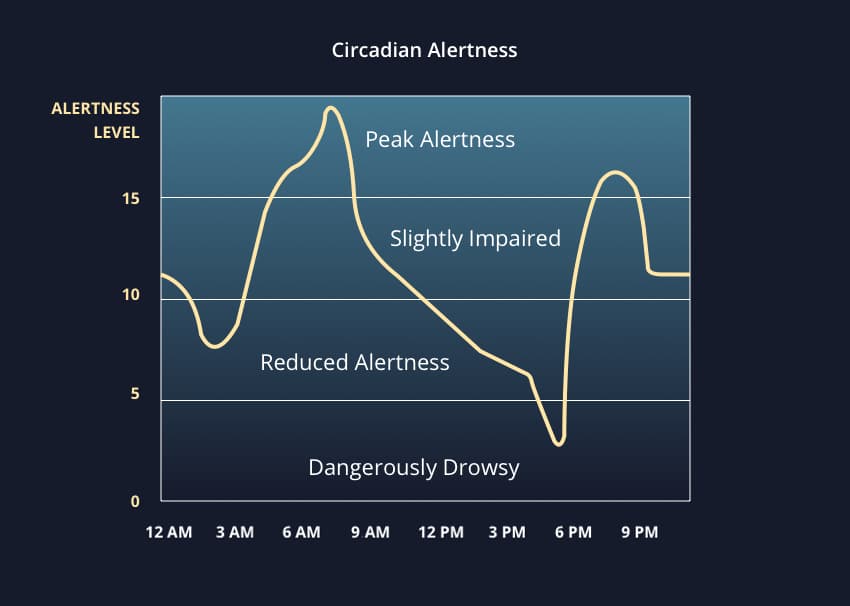
When?
Here are 2 reasons why you should do your learning during the morning:
-
A few hours after you wake up, your body has its highest peak in concentration and alertness.
-
As the day progresses, your mental energy will decrease. Start your day with the hardest tasks to set yourself up for success.
Where?
You simply cannot focus in an environment full of distractions.
Remove them, go to a quiet place, wear headphones.
Every distraction that’s still there is another obstacle that your brain needs to battle using precious, oh-so-precious mental energy.
Save yourself the hassle and put your phone in a different room.
Active Learning
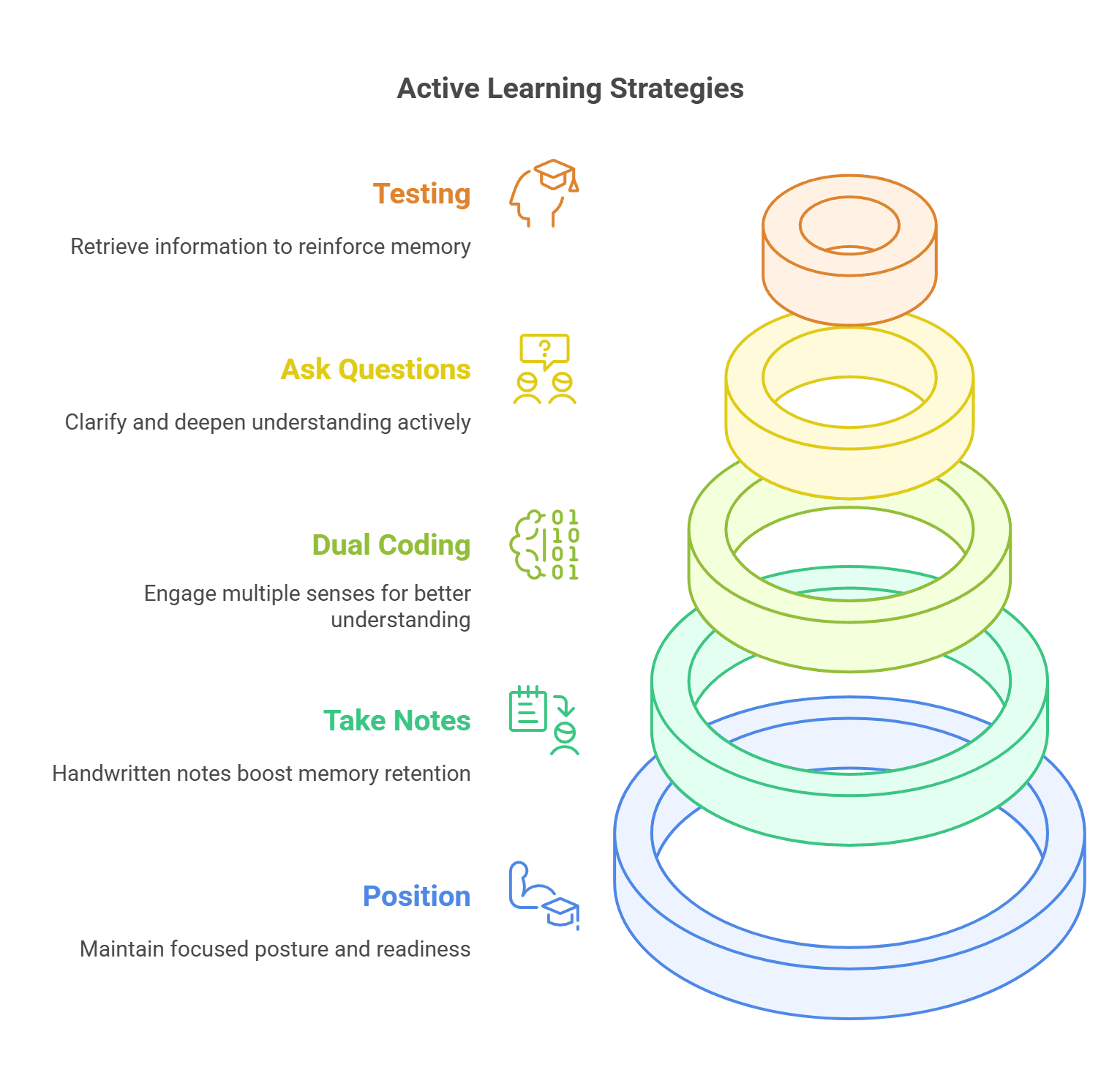
Active learning is all about HOW you learn.
As mentioned before, you’re not learning productively if you’re passively listening to or reading something.
Here are a few key tips to be active while learning.
1. Position
Make sure you’re maintaining a focused, straight posture. Sit down (or stand up) at a desk and have your course material, pen and paper ready.
2. Take Notes
During your study session / lecture, take notes. This forces your brain to be active.
Boost this even further by taking handwritten notes instead of using the computer.
There are multiple reasons why:
- Writing helps your brain encode and remember information better.
- Since writing by hand is slower, you’ll be forced to prioritize what to write down, and essentially you’re working hard trying to distinguish the most important information.
3. Combining Senses (e.g. Dual Coding)
By combining different senses while learning, you activate and engage multiple parts of the brain. This helps with memory retention but can also help you understand concepts better.
For instance, visualizing a math problem.
By the way: It helps if you learn in different environments so your memory doesn’t associate one place too much with learning.
4. Asking Questions
If you don’t understand something or want to confirm that you do understand it, you can and should ask questions.
For instance, if you learned that iron will rust when in contact with oxygen, then you could ask your teacher (or the Internet / ChatGPT) if it will rust in water since water’s made of hydrogen and oxygen.
This way, you can confirm if your thinking was right and you actively participated during a lesson.
Furthermore, asking questions like:
- “How can I apply this knowledge?”
- “How does it work?”
- “What if ‘A’ happened to ‘B’?”
can help you think actively about what you’ve just learned and motivate / spark interest in you too :)
5. Testing
This is by far the most important step.
Studies have shown that you forget up to 50% of what you’ve learned after an hour. The best way to combat this is not by repeating or reviewing the same thing twice, but to try and retrieve what you know by testing.
This way, you’re forcing your brain to think hard, and it sends a signal that this information was important!
Then afterwards, you can review those concepts which you’ve forgotten.
Remember: POTACOASTE
The 5 key points for active learning are:
Position
Taking Notes
Combining Senses
Asking Questions
TestingPoTaCoAsTe
The 30 Second Rule
An awesome method to combine those different ideas at the end of a learning session is “The 30 Second Rule.”
Essentially, after learning something, write down the key concepts / most important information in 30 seconds.
You’ve got to ask yourself what’s the most important and write it down (taking notes) while only using your memory (meaning you’re testing yourself).
Testing: Use It as an Assessment or a Learning Tool?
Most likely, after reading this title you groaned. Or perhaps felt an urge to skip this part.
That’s understandable since most of us don’t have fond memories of testing. It reminds us of those regular tests each week in class or the time-pressured exams where you had to remember massive amounts of information. Or it reminds us of the stress of waiting to find out what result you got.
It really is a shame that school has given testing such a bad connotation because the research behind testing proves that it’s one of the best ways to learn.
Yes, not only to evaluate yourself but to LEARN.
While a graded test might indicate your progress and pain points, it simultaneously stimulates your brain to retrieve knowledge and how to use it.
There is tons of research emphasizing how testing is one of the most effective ways to remember information and master new skills.
(In fact, I listened to a 2-hour podcast from Andrew Huberman about learning, and my main takeaway was that testing yourself is really important.)
But this doesn’t mean you need to take massive tests / exams and then get graded on them.
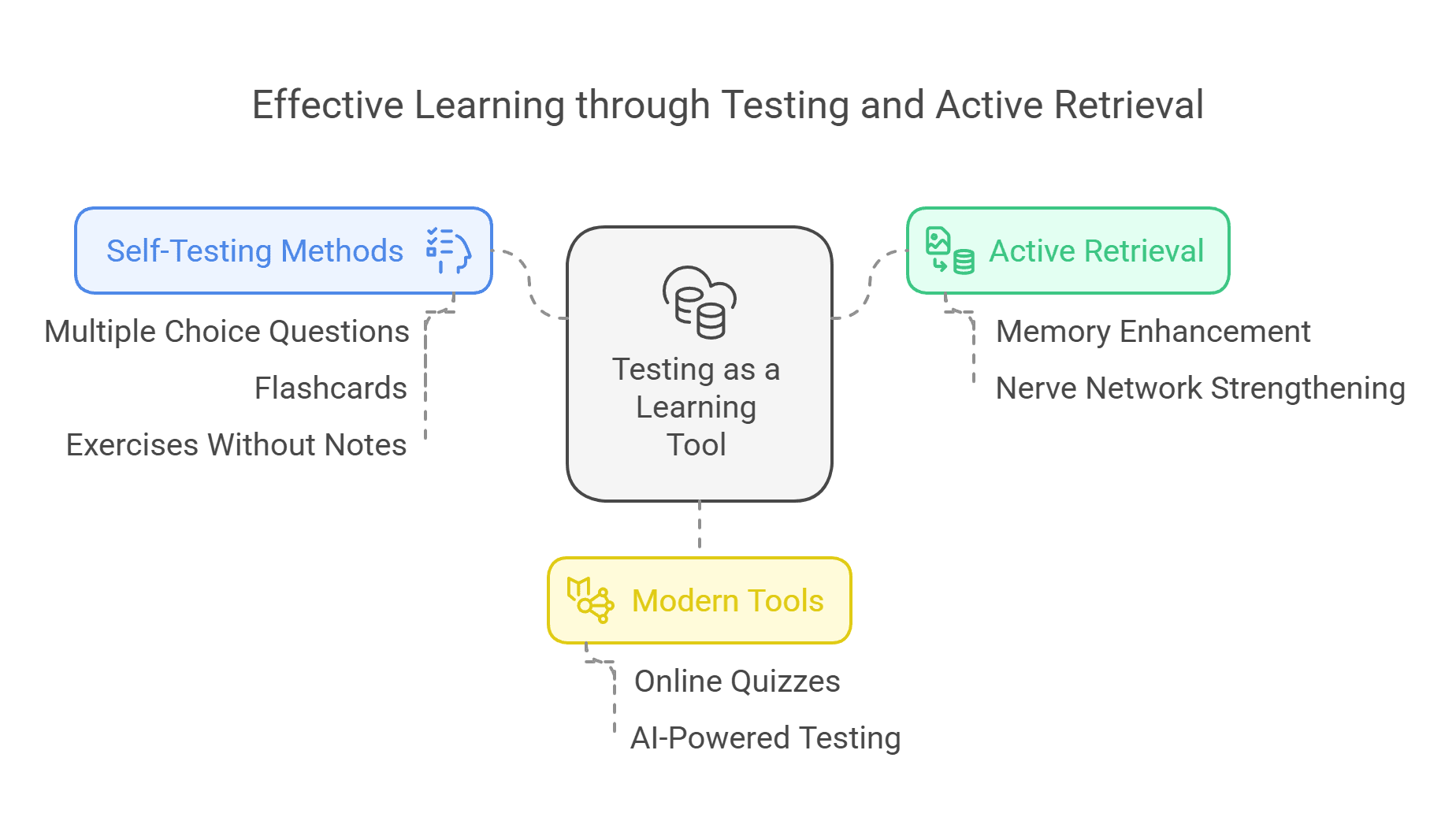
No, instead you can implement active retrieval.
Small little questions that you try to answer after learning information or when reviewing it later on, only using your memory.
And it doesn’t matter at all how much you get right! The process of retrieving info is strengthening those neural networks.
Examples of Self-Testing
Multiple-Choice Questions & Filling in the Empty Gaps
When you’re first learning a concept, these are a nice way to check if you understand something. Then later on, you can try retrieving info without any possible cues.
Flashcards
Great for vocabulary or definitions. It’s also quite fun and easy to set up with online tools like Quizlet or Knowt.
Solving Small Exercises or Problems Without Looking Back at Your Notes
This one is easy to implement but might feel a bit hard.
Next time you have to solve a problem, try first without looking back at formulas, tutorials or documentation (if you’re coding, for example) and see if you get it right.
Quizzes
They’re basically the same as tests but just a more fun word for it.
But How Do You Get / Create All This Testing Material?
Nowadays, it’s easier than ever with online quizzes, exercises and tools (like flashcard systems).
And alternatively, you can paste your notes into an AI and ask it to test you on them.
The possibilities are endless.
Find this useful?
Support the blog or follow me for more daily tips.
Summary
Learning how to learn might be one of the most useful skills you can have, because it helps you learn pretty much anything else faster and better. The key is to be both focused and active while learning, instead of simply reading or listening and hoping the information sticks. Let me convince you HOW & WHY this works!
Find this useful?
Support the blog or follow me for more daily tips.